
Foreign Investor Due Diligence: What the Standard Checks Miss
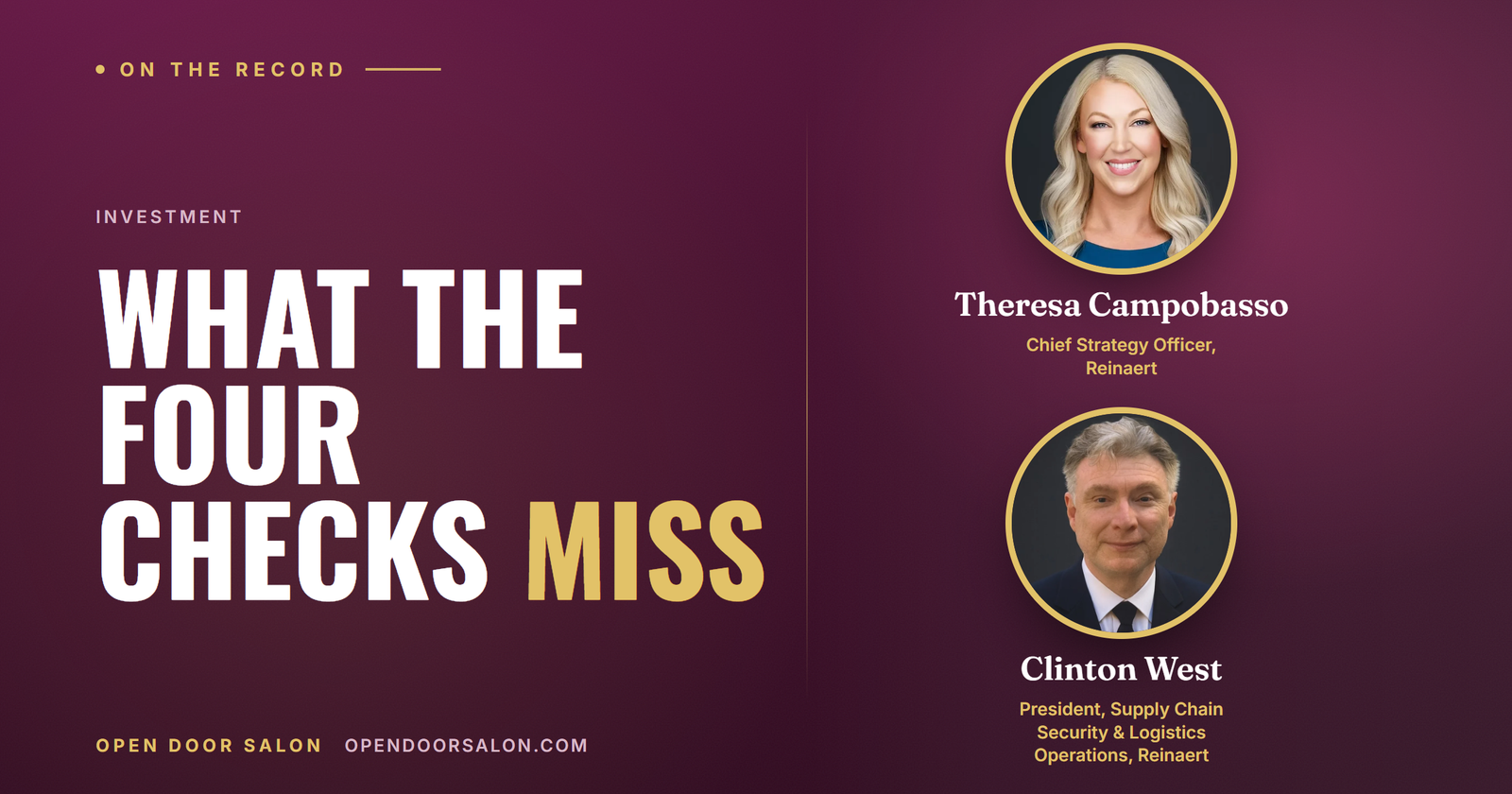
Foreign investor due diligence should look past the four standard checks of legal, financial, reputational and regulatory risk to the network of people and entities that can steer an investor’s behavior. That was the argument Theresa Campobasso, chief strategy officer of Reinaert and a former U.S. Marine Corps intelligence officer, made on Open Door Salon. Clinton West, Reinaert’s president of supply chain security and logistics operations and a former CIA supply chain risk leader, described how a company can start.
What do standard due diligence checks cover?
Four categories, and for a long time only those four. Campobasso described the standard frame:
For years and years and years, mergers and acquisitions, corporate investment, anybody who was doing corporate diligence really only looked at four categories. It was like legal, financial, reputational, regulatory.
Those checks confirm that a counterparty is not sanctioned, is financially healthy and has no legal or regulatory problems. They say little about why it might act against a company’s interests later.
What can a foreign investor do that the checks miss?
Use its capital for reasons other than returns. Lori Ellis raised a case she had heard more than once. A Minnesota medtech company said its lead investor, a Hong Kong-listed pharma company, held back promised capital and blocked U.S. investors, then partnered with a Chinese competitor. Campobasso called the pattern economic statecraft:
This is very much a behavior that we see in what we would consider kind of economic statecraft leveraging capital to perhaps achieve political or geopolitical ends.
She added that the behavior is not unique to China, and that the United States uses capital the same way at times. For a startup that has planned around promised money, the effect is the same whoever does it.
What else should diligence look at?
The whole network around the company. Campobasso said the model she finds most predictive looks at everything that could influence a counterparty’s behavior:
Let’s look at the whole network of entities that could be influencing the behavior of the company that we’re looking at.
That also means widening what counts as a risk indicator:
Let’s include all sorts of additional types of risk indicators to look for.
She listed the questions she would add, starting with past conduct and the board:
How has this company behaved in the past? Maybe who’s on their board of directors and what affiliations do those individuals have?
Then its digital behavior and the people it hires:
Is there any pattern of digital behavior? Is there any pattern of hiring people with particular affiliations?
Is a red flag proof?
No. Campobasso was clear that most indicators will not add up to anything:
Maybe these are just indicators and in aggregate, they really don’t rise to be anything, but it’s always good to ask.
The point of a wider net is to reduce the chance of being surprised by a situation the company never prepared for, such as an investor withholding capital and helping a competitor.
How should a company start?
Small. West said the first step is to define the objective. Vetting one person is a hub with a few spokes; vetting a company as an investment partner turns those spokes into hundreds or thousands of information assets. For companies unsure what the work will cost or how long it will take, he recommends a first pass:
One of the things that we’ve seen to be something that companies can swallow early on is just doing what we call a sprint.
A sprint looks at the top 10 or 15 first. Some of what it finds can be fixed in a week; some takes years. West said the result is a clearer picture of both halves of the job:
I found that these sprints really helped to frame the problem, but more importantly helped frame the mitigation that needs to be put in place.
Does the same apply to licensing an asset?
Yes. Lori asked what diligence an investor or acquirer skips when licensing an asset from a Chinese developer. West’s answer was the same method: define the objective, examine the existing process, add a tool that fits it and drive the mitigation. An investor and a biotech chief executive who license from China describe the on-the-ground version in due diligence for licensing drugs from China. Campobasso’s earlier guide to mapping sub-tier supply chain risk applies the wider net to suppliers. The COINS Act, enacted in December 2025 through the defense authorization bill, does not cover biotech; a June 2026 House bill would add it. The guests’ warnings on insider threat signals and on why trade secret lawsuits are hard to win explain why the diligence has to happen before the deal.
The full conversation is on the Open Door Salon episode page, with more about Theresa Campobasso and Clinton West.
Companies that want to reach the leaders who follow this conversation can learn about sponsoring Open Door Salon.
This post is drawn from the recorded, on-the-record conversation between Lori Ellis, Theresa Campobasso and Clinton West on Open Door Salon; quotes are lightly edited for clarity, and the full episode is the record.