
Can Sharing Research With AI Destroy a Patent?
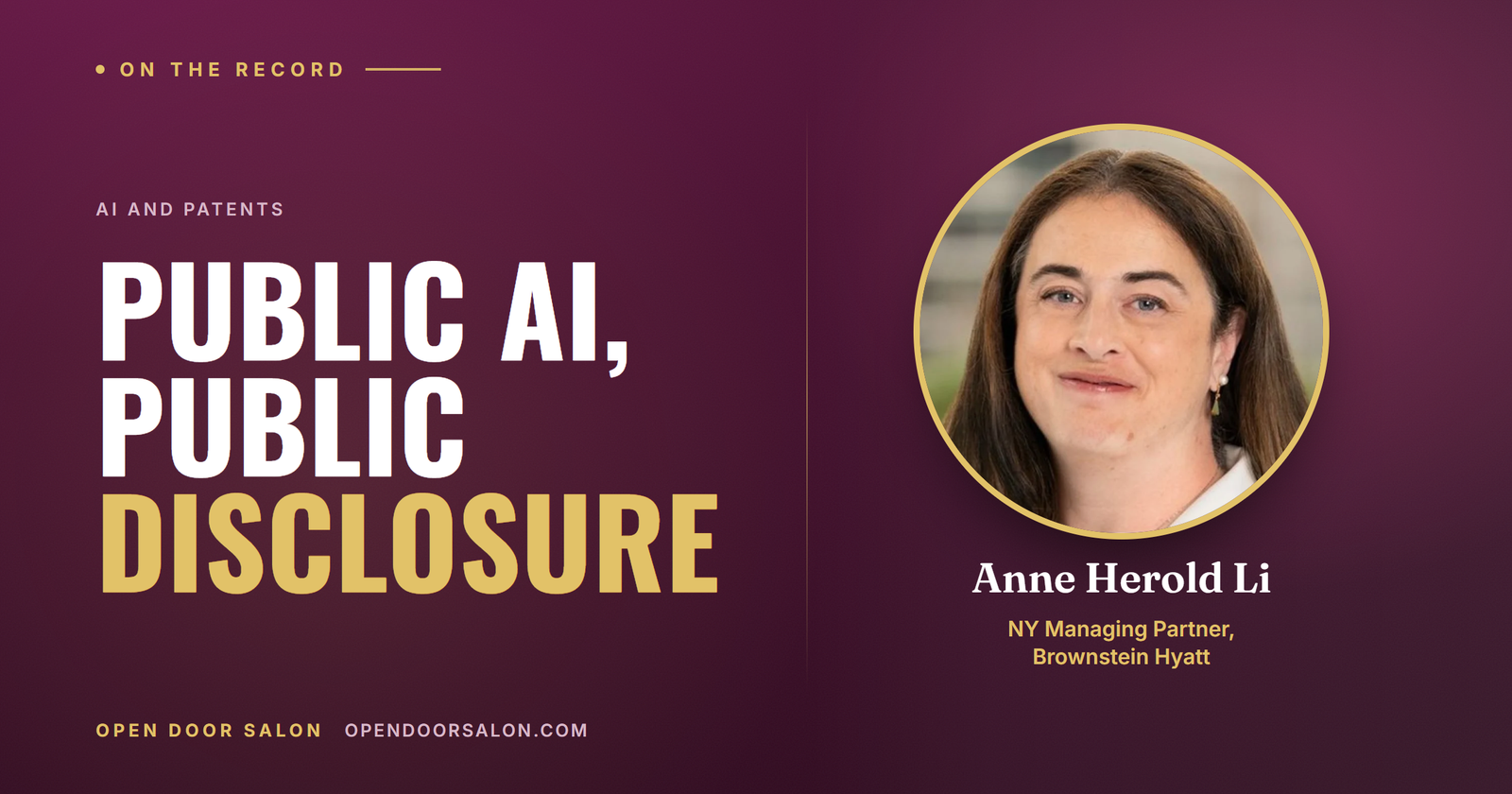
It can. Almost everywhere outside the United States, any public disclosure of an invention before a patent application is filed destroys patentability, and an AI tool that reveals unfiled work can count as that disclosure. Anne Herold Li, shareholder at Brownstein Hyatt Farber Schreck and managing partner of its New York office, explained the risk on Open Door Salon. The United States gives inventors a one-year grace period, so a researcher in that position might still get a US patent, and nowhere else.
Herold Li is a first-chair patent trial lawyer who trained as an epidemiologist. Her advice to scientists starts with a single rule:
Do not share secret things. Just don’t do it.
Why does a public AI disclosure matter for a patent?
Because outside the United States, novelty is absolute. Herold Li described it as a doctrine most people never think about until it bites. If an invention is published before filing, by the inventor, by a tool or by anyone else, it can no longer be patented in most of the world:
It’s public disclosure. And now it’s destroyed patentability for what they didn’t file on already.
She was speaking about a researcher whose unfiled work may have surfaced in a public AI tool’s output. In that situation, she said, the second patent application the researcher was preparing is probably gone, because the material in it is now public.
What happened with the Copenhagen enzyme dispute?
In September, Anthropic announced that its Claude model had found a new enzyme system. Within days, a University of Copenhagen researcher told The New York Times that his team had studied the same enzymes for about four years and had used Claude while drafting their unpublished work. Anthropic said it does not train Claude on users’ conversations and was not aware of published work on the system, and the team’s claim rests on materials that are not public. Herold Li’s point does not depend on how that dispute is resolved. It is about what researchers should assume when they type into a public tool.
Why is a small research field more exposed?
Because a model learning from a handful of specialists has very few places its answer could come from. Herold Li contrasted the question millions of families ask about a national parks road trip with a question about one class of enzymes:
You’ve got to think that the University of Copenhagen researchers have a very small universe of people who even understand what it is that they are doing, right?
In a field of perhaps fewer than 100 researchers, she said, anything a tool draws on is close to traceable, and anything it reveals may have come from someone’s unpublished data. She added that there is debate in the IP community over whether information is still considered confidential once it has been put into a public tool at all.
Does the US grace period protect the inventor?
Partly, and only in the United States. US law, at 35 U.S.C. 102, gives inventors one year to file after certain disclosures of their own work. Herold Li described the rule as a concession to inventors who get excited and talk:
If you or one of the co-inventors disclose your invention, there’s a one-year grace period ... which again would just be in the United States because we’re an exception to this global rule.
So a researcher whose work surfaced through an AI tool might still get a US patent, she said, but nowhere else. For a drug or platform with global value, losing every market outside the United States is most of the asset. A separate question is whether an invention made with AI’s help can be patented at all; we cover where that line falls in can you patent an invention made with AI.
What should researchers do instead?
Keep proprietary work out of public tools entirely. Herold Li named the tasks that tempt people most, because they are tedious and AI does them fast: a pitch deck, the first draft of a patent application, an invention disclosure form. Her alternatives were a proprietary AI environment whose data stays inside the institution, or a local copy on a computer that never connects to the internet. She also told scientists to stop announcing results early, which she acknowledged sits uneasily with the pressure to publish or perish. Our post on whether biotech employees should use public AI tools takes the same rule to every company device.
For how to use these tools on research that is not confidential, our earlier post on how to prompt AI for scientific research covers the method.
What does this mean for drug development?
Herold Li sees a tension that will play out over years. AI companies doing their own research could speed up new treatments, which is good for patients. But the molecule is the most valuable intellectual property in nearly every portfolio, and disclosure rules could make those molecules harder to protect:
And suddenly they can’t patent the molecules anymore.
She called it a narrow rule that nobody pays attention to unless they are a patent lawyer, and one that is likely to shape how AI research in the life sciences develops.
Companies that want to reach the leaders who follow this conversation can learn about sponsoring Open Door Salon.
This post is drawn from the recorded, on-the-record conversation between Lori Ellis and Anne Herold Li on Open Door Salon; quotes are lightly edited for clarity, and the full episode is the record.