
How Long Do Biotech M&A Deals Take? Longer Than the Headline
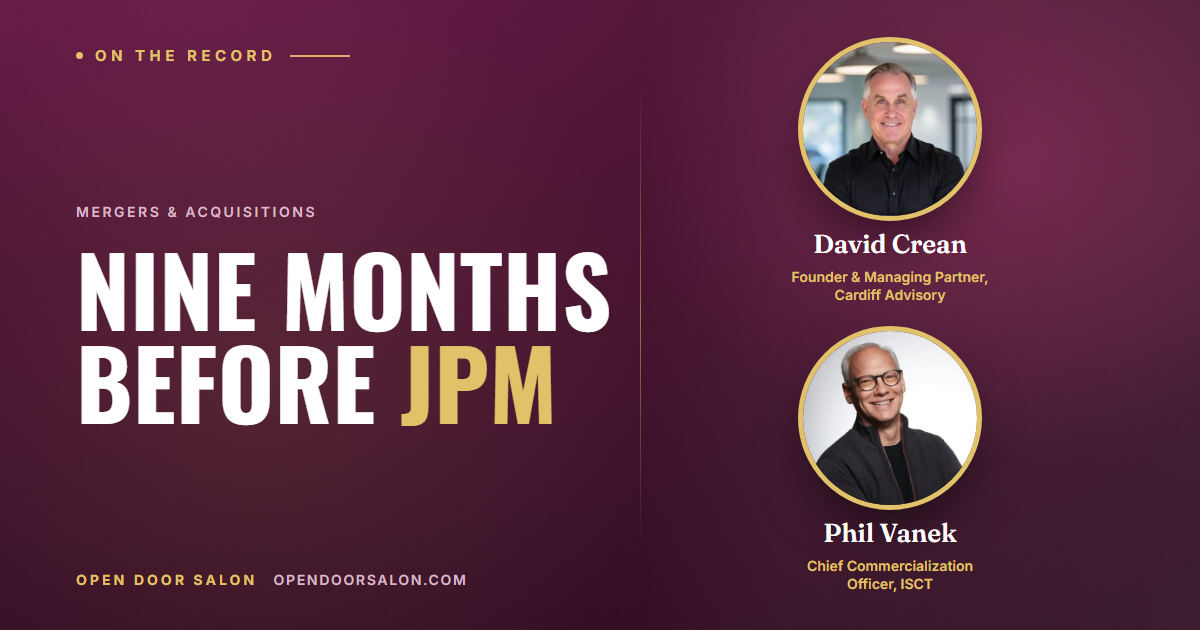
A biotech merger or acquisition usually takes many months of relationship-building before anyone announces it. David Crean, an investment banker and founder of Cardiff Advisory, told Lori Ellis on Open Door Salon that a deal announced at the J.P. Morgan Healthcare Conference typically began about nine months earlier. With Asia-Pacific counterparts, he said, it can be two years. Phil Vanek, chief commercialization officer of the International Society for Cell & Gene Therapy (ISCT), added that the relationships behind a deal can take years to build.
Why does a JPM deal announcement look sudden?
Because the announcement comes at the end of the process. Crean described the pattern from his M&A banking work: people hear the headline that company A acquired company B on the first Monday of JPM. In his experience:
Those discussions started like nine months prior to that and they just held on to it.
He added that the deal was probably signed shortly before the J.P. Morgan Healthcare Conference and then announced there. Lori Ellis said she had always been surprised by how long those relationships take, and Crean confirmed it.
Can a founder meet an acquirer at JPM and close that week?
Crean said no, and it is a misunderstanding he hears from young companies:
Oh, this is why I got to go to JP Morgan, because this is where I'm going to get, I'm going to meet somebody and they're going to acquire it that day. It's like, no, it's not that.
The relationships behind a deal take time to build, he said. He put the typical lead time at six to nine months, and sometimes two years with Asia-Pacific companies, with a lot of cultivation before the deal is announced.
What should an early-stage CEO do instead?
Start the relationships early and keep them informed. Crean's guidance:
Start to cultivate those relationships, understand who your buyer universe is or even your partner universe and start working that magic.
Crean was specific about what that early outreach should communicate:
Letting companies, a larger company, know about what you're doing, why you believe your therapy is going to be completely unique and transformational, why they need to have you guys on the radar.
Those conversations should happen as early as possible, he said, and they do not end once they start:
And then ultimately keeping those companies up to date with your progress. That's what I always like to tell CEOs who are developing very innovative treatments and why they need to cultivate that relationship.
Who is at the table when a deal comes together?
Almost everyone, all the time. Vanek described a market where developers, investors and bankers are continually in conversation:
Everyone's always around the table and meetings like JP Morgan where everybody's kind of walking around with their full dance cards are always networking and discussing.
In his view, bankers are part of the equation whether the goal is a transaction, further capital for a new phase, or an introduction to a buyer or another sponsor. He described the market as permanently in motion:
Everyone's always shopping for great assets and investors are always looking for things to underwrite and developers are always looking for more capital.
Why should founders do diligence on their investors?
Because investors bring networks as well as capital, and those networks shape the eventual deal. Vanek gave this advice to founders in any field:
Treat your investor and actually do diligence on your investment partners, because they not only bring capital to the table, they do bring these networks and these natural relationships, whether it's later-stage investors, PE or the bankers that ultimately will help transact and put value against the company.
He also told founders to build their own reputation:
You have to get known. Investors like to invest in known assets or asset classes that they're familiar with, but they also invest in people.
His practical suggestion was to put well-regarded key opinion leaders on the board. Earlier posts in this series cover what investors need to see first: the target product profile, CMC in cell and gene therapy and when to plan for reimbursement. The decision that comes before a deal, which asset a board chooses to fund when it cannot fund everything, is covered in how biotech companies prioritize their pipeline.
How long do these relationships take to build?
Sometimes years. Vanek, who described himself as an investor in underpinning technology rather than therapeutics, said:
These relationships sometimes can take years.
His closing word on the subject was one word, repeated three times: relationship. For more on how investors read the people behind a company, see what investors look for in a biotech founder.
Companies that want to reach the leaders who follow this conversation can learn about sponsoring Open Door Salon.
This post is drawn from the recorded, on-the-record conversation between Lori Ellis, Phil Vanek and David Crean on Open Door Salon; quotes are lightly edited for clarity, and the full episode is the record.