
Why Do Biotechs Chase the Same Drug Target? Insiders Explain
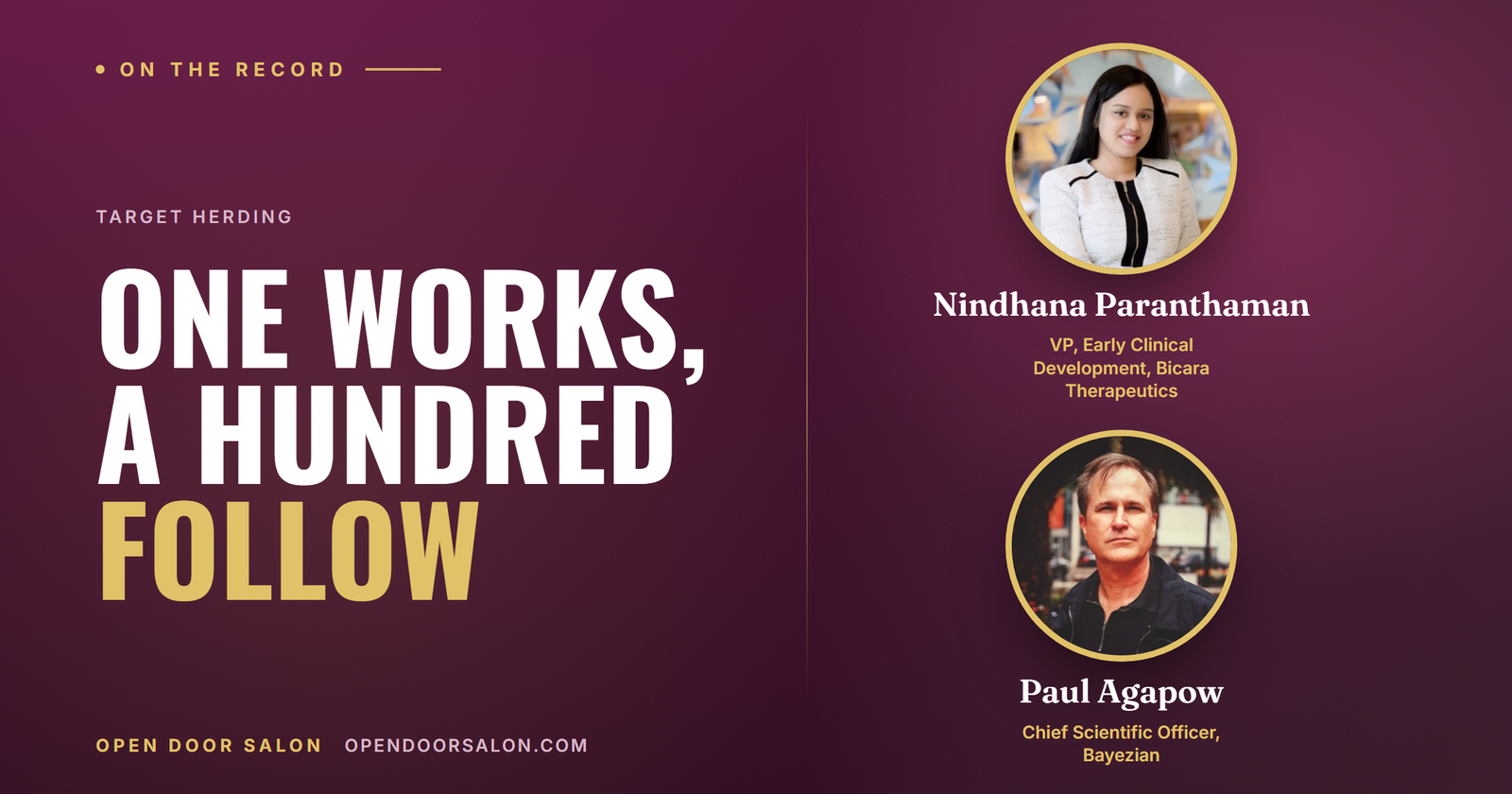
Because crowding a proven target is the cheapest way to reduce risk in an expensive business. When one or two companies show that an asset works, capital and teams move toward the same target rather than toward an unproven one, and the industry ends up with many versions of the same drug. Two people who see this from different seats, a clinical development leader and an AI scientist, described the same pattern on Open Door Salon and neither of them treats it as irrational.
Nindhana Paranthaman is VP of early clinical development at Bicara Therapeutics. Paul Agapow is chief scientific officer at Bayezian. The conversation turned to capital after a question about the most expensive mistakes either had seen, and the answer led straight into how money follows proof.
What does target herding actually look like?
Paranthaman describes it from the investment side, as a count.
If one person or maybe two companies have shown success with one asset, then a hundred new companies pop up that are also trying to develop the same asset.
She expects AI investment to behave the same way. Where a model or an approach shows a result, money concentrates behind it rather than spreading across the gaps in the ecosystem. The pattern is not specific to therapeutics; it is what capital does when proof is scarce and expensive to generate.
Agapow gives the behavior its name.
There's there's an awful lot of target herding going on.
How much has pipeline diversity actually narrowed?
This is the most falsifiable claim in the conversation, and Agapow states it as a figure.
The diversity of pipeline drug development pipeline has fallen by 50% in something like the last 15 years, that everyone is doing me too drugs.
The direction is documented, if not at that exact magnitude. An analysis of target diversity in drug development found that approximately half of drug targets were being pursued by more than one company, and that Phase III trials showed the most competition, with about a third of targets under development by five or more companies. That assessment was published in 2013, which is itself a measure of how long the dynamic has been visible. Agapow makes the point concretely by asking how many GLP-1 drugs the field actually needs.
Is chasing a proven target irrational?
No, and this is the part that makes the problem hard. Agapow extends real charity to the people doing it.
It's tremendously risky and expensive enterprise, drug development. So people are derisking by moving towards targets that are obvious.
A novel target carries scientific risk on top of clinical and commercial risk. A validated one removes a layer of uncertainty from a process that is already long and expensive. Each individual decision to follow the proven path is defensible. The cost lands at the level of the field rather than the company, which is exactly the shape of problem no single actor can fix.
What should an investor look for instead?
Agapow's answer is about the stance of the team.
Someone going in with, you know, a very opinionated stance, understanding their disease, understanding the nuances of it.
He contrasts that with a company promising to solve all diseases everywhere, which he treats as a signal that the team has not committed to a specific problem. Knowing your modality and your target, in his framing, is what gives a program a chance of surviving the rigors of phase two and phase three. A target product profile written at the start is one way to make that commitment explicit.
What is the clearest red flag?
He names one directly, and it is the sharpest line in the closing stretch.
Look out for anyone who's trying to use technology to hack their way around biology.
Engaging with wet lab work early is, in his view, non-negotiable. A team that treats biology as an obstacle to be routed around with computation is a team that has not yet met the part of the problem that decides whether a drug works. It is the same instinct behind expecting a model to stand in for a trial participant, which is the question we took up in whether a digital twin can replace a patient in a clinical trial. Agapow's fuller case for why biology resists those shortcuts is in why biology is hard for AI.
Does focus actually correlate with success?
Paranthaman's version of the same advice comes from watching small teams.
They weren't ... split across the board with multiple assets in their portfolio, but they decided to ... laser focus on one or two.
The teams she has seen reach market were concentrated on the assets they had the most conviction in. She gives AI companies the same counsel: get one therapeutic area right before generalizing across several. For an investor, that turns into a question a founder can be asked directly, which is where conviction actually sits and what was given up to hold it. The same guests named the unglamorous place where AI pays back soonest, in how to reduce protocol amendments in clinical trials.
What does this mean for a founder raising now?
The two views point the same direction without quite closing. Capital rewards the proven target, and both guests describe founders responding rationally to that. Both also say the companies they would back are the ones refusing the obvious path in favor of a specific, defended position. That tension is not resolved in the conversation, and it may not be resolvable from inside a single funding decision. What a founder can control is whether the opinionated stance is real and whether the biology has been engaged early enough to defend it. When a company cannot fund every program, an investment banker and board director describes how boards choose between assets in how biotech companies prioritize their pipeline.
This piece is drawn from the recorded, on-the-record conversation with Nindhana Paranthaman and Paul Agapow on what AI actually delivered in clinical development. Related reading on the economics behind these decisions: why AI is so expensive for companies to run. If your organization wants to reach the people allocating capital inside drug development, that conversation starts here.